
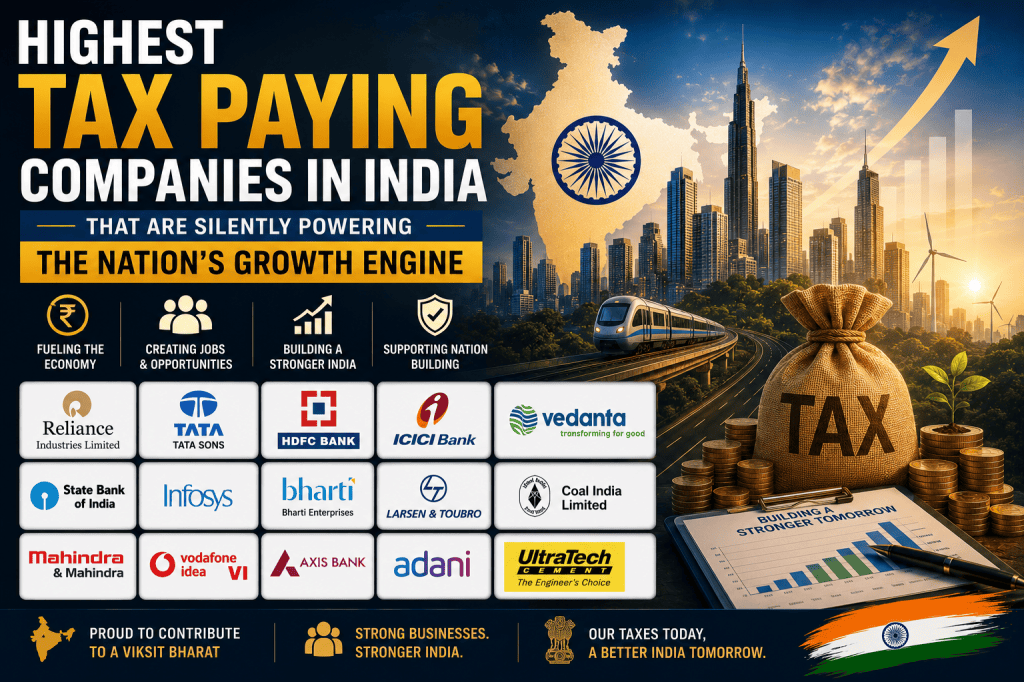
India’s economy doesn’t run on policy alone. Behind every new highway, every rural hospital, every scholarship that changes a first-generation student’s life, there’s a less glamorous force at work. Corporate tax revenue. And the highest tax paying companies in India are quietly doing some of the heaviest lifting, even if no one’s throwing a parade for them.
We talk a lot about FDI, GDP growth & government schemes. But here’s what often gets buried: in FY 2024, the country’s top corporate taxpayers accounted for nearly 19% of India’s provisional gross corporate tax collection of ₹2.2 lakh crore. That’s not a rounding error. That’s nation-building at scale.
So who are these companies? And just how much are they contributing? Let’s get into it.
Why Corporate Tax Contributions is Important for Country’s Growth?
India’s tax-to-GDP ratio has been improving, but it still trails behind most comparable emerging economies. That gap makes the role of large corporates, the top tax contributors in India far more critical than it might appear on the surface.
When a company like Vedanta or Reliance pays its taxes in full and on time, it’s not merely ticking a compliance box. It’s funding the systems that allow India to grow, compete globally & take care of its people. Think about what that money actually does:
- Roads, railways & digital infrastructure gets built
- Public healthcare and education systems get funded
- Defence budgets stay intact
- Research and innovation programmes find their footing
These aren’t abstract outcomes. They’re what happens downstream when a few large companies write very large cheques to the government every year.
Vedanta Limited: The Growth Story No One’s Talking About
If one picks Vedanta to understand what has changed on the corporate tax front over last a few years in India, they will be not be mistaken.
Vedanta contributed ₹62,722 crore to national exchequer in FY 26, its second highest ever, representing ~36% of consolidated turnover
In FY 2024-25 Vedanta Limited paid ₹12,826 crore as Tax. That kind of growth doesn’t come about by accident. It is a sign of a business machine firing on all cylinders. And zooming out even further, Vedanta’s total contribution to the exchequer in FY25 including direct taxes, indirect taxes, royalties, and dividends reached a staggering ₹55,349 crore, which amounts to 37% of its consolidated revenue for the year.
Vedanta’s operations span zinc, aluminium, copper, iron ore, oil and gas & power. These aren’t peripheral industries. They’re the raw material of India’s industrial backbone, the stuff that goes into factories, construction projects & energy grids across the country. And the royalties, duties & taxes Vedanta pays flow into both central and state government treasuries, often in regions that need it the most.
But it’s not only the size of cheques that distinguishes Vedanta. It’s the transparency around them. The company published its 11th Tax Transparency Report 2026, laying out its tax policies, effective rates & governance commitments in plain terms. That kind of openness is still rare in Indian corporate circles. It signals something important that a company can be commercially ambitious and ethically grounded at the same time. Not a trade-off. Both, simultaneously.
That’s worth paying attention to.
The Other Highest Tax Paying Companies in India And the Numbers Behind Them
Vedanta’s rise is a compelling story , but it’s part of a much larger picture . Here are the other corporations that consistently show up when you look at who’s actually funding India’s growth engine.
1. Reliance Industries Limited ₹25,707 crore (FY 2024–25)
Reliance is up there and by a huge distance. The company paid ₹25,707 crore in corporate taxes in FY 2024 the largest amount paid by any one Indian entity in that financial year. Reliance pays the most taxes in India, it has a stake across petrochemicals, refining and also retail & telecom via Jio; its tax payments alone can fund over several mid sized government schemes. It has been as it is year after year. That level of consistency matters.
2. Tata Consultancy Services (TCS) ₹15,898 crore (FY 2024–25)
TCS stood second with the highest tax contribution in FY 2024 to the national exchequer at ₹15,898 crore. The Indian market tax contribution of TCS is even more significant as the majority of its revenues come in foreign currency. A business that generates income globally and invests locally. In every sense, a quiet beast.
3. State Bank of India (SBI) ₹16,973 Crore (FY 2023)
With ₹16,973 crore paid in taxes in FY 2022–23, SBI is the largest public-sector bank and the sole Indian bank to make it to Fortune Global 500. This is more than just a banking metric for your company’s financial health. This is directly attached to the economy of India. Billions of accounts, billions of transactions & one very big annual tax bill.
4. HDFC Bank ₹11,122 crore (FY 2024–25)
The most profitable private-sector bank in India shelled out around ₹11,122 crore for FY 2024–25. HDFC Bank remains in the top-most corporates in terms of tax payments due to its underlying fundamentals a growing loan book, strong net interest margins & a rising customer base maintaining profits despite post-merger adjustments that weighed on them for subsequent years.
Conclusion
These companies don’t get ribbon-cutting ceremonies for their tax payments. There’s no viral moment when Vedanta files its transparency report or when Reliance writes its annual cheque to the government. But every time a highway gets completed on schedule, every time a public hospital receives fresh equipment, every time a government scholarship reaches a student in a tier-3 city a fraction of these contributions iplays a role somewhere.
Vedanta’s 122% surge. Reliance’s ₹25,707 crore. TCS’s steady, reliable presence in the top two. These aren’t just financial statistics sitting in an annual report. They’re the quiet architecture holding up India’s ambitions.
As India pushes towards a $5 trillion economy, this is the part of the story that deserves more airtime.


Leave a comment